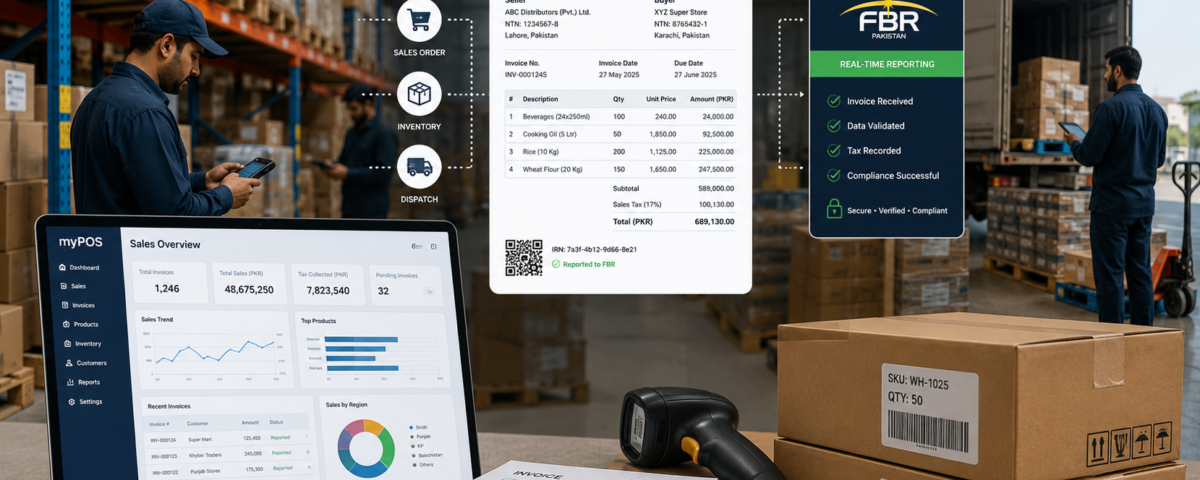
For years, wholesale and distribution businesses in Pakistan ran on paper-based or loosely digitized invoicing, with bulk orders, credit sales, and multi-party transactions rarely scrutinized in real time. That’s changing. FBR digital invoicing now requires wholesalers and distributors to generate, report, and store invoices in a structured, verifiable format, often at the point of sale rather than at month-end reconciliation. If your business moves goods in volume, whether to retailers, sub-distributors, or institutional buyers, this shift affects how every transaction is recorded and reported, not just how taxes are eventually filed. Understanding what’s actually required, and what it takes to prepare for it, matters more here than in most other sectors simply because of transaction volume.
Why Wholesalers and Distributors Are Under the FBR’s Radar
Bulk trade has historically been harder to track than retail. A single distributor might issue hundreds of invoices a week across different buyers, price tiers, and payment terms, and much of that volume moved through informal or partially digital systems that left plenty of room for underreporting, whether intentional or not. The FBR’s push toward real-time, standardized invoicing closes that gap. The requirement for digital invoicing in Pakistan has been framed as mandatory rather than optional for a growing list of sectors, and distribution businesses are increasingly falling within that scope because of the sheer transaction volume they handle. The reasoning isn’t unique to any one industry, but wholesalers feel it more acutely simply because of scale, and because their invoicing touches so many downstream buyers at once.
How Digital Invoicing Works for Bulk and B2B Transactions
Unlike a single retail sale, a wholesale transaction often involves credit terms, partial payments, and returns that need to be reflected accurately across multiple records. Digital invoicing changes several things at once:
- Invoices are generated with a standardized structure that includes a unique identifier for each transaction
- Data is reported to FBR systems close to the time of sale rather than batched later
- Buyer and seller tax details are captured automatically, reducing manual entry errors
- Credit notes, returns, and adjustments need to be logged as distinct digital records, not informal corrections
- Historical invoice data has to remain retrievable in a consistent digital format, not scattered across ledgers or spreadsheets
For a business used to handwritten or spreadsheet-based ledgers, this is a structural change in how sales data moves, not just a paperwork update, and it usually requires rethinking invoicing workflows for volume rather than single-till retail, since bulk order patterns behave very differently from a typical retail checkout.
Key Compliance Deadlines and Penalties to Know
Timelines for digital invoicing adoption have shifted more than once, and penalties for non-compliance are tied to specific rollout phases rather than a single fixed date. Businesses that delay integration often assume they have more runway than they actually do, especially when relying on outdated guidance from earlier phases of the rollout. It’s worth checking the current compliance deadlines directly rather than assuming last year’s deadline still applies, since enforcement dates have moved as the FBR expanded coverage to more sectors, and penalties tend to scale with how long a business has been non-compliant.
Where FBR Rules Differ from Provincial Tax Systems
Distributors operating across provinces run into a separate layer of confusion: federal FBR requirements aren’t identical to provincial sales tax obligations under bodies like KPRA or SRB. A distributor selling into Sindh and Khyber Pakhtunkhwa from a single warehouse may need to reconcile more than one reporting framework depending on where the buyer is registered, and the invoice format expected can vary slightly between systems. Understanding federal vs provincial tax rules matters more for distribution businesses than for single-location retailers, precisely because multi-province selling is common in this segment and rarely handled by a single, uniform process.
What Wholesale and Distribution Businesses Need to Prepare
Before integrating a digital invoicing system, most distributors need to address a few operational gaps first:
- Clean, consistent product and pricing data, since mismatched SKUs cause reporting errors
- A clear invoice numbering convention that doesn’t duplicate across warehouses or branches
- Staff trained on issuing digital invoices at the point of dispatch, not after the fact
- A backup process for connectivity issues, since real-time reporting assumes a stable internet connection
- A reconciliation routine between stock movement and invoice records, since the two need to match consistently
Businesses that treat this as purely an IT install, rather than a process change, tend to run into the most friction during rollout. Inventory accuracy in particular tends to surface as the real bottleneck, since invoicing and stock records need to match line for line, which is where distribution management tools become relevant alongside the invoicing layer itself.
Common Mistakes Businesses Make During the Transition
A few patterns show up repeatedly among distributors moving to digital invoicing. Some try to layer a compliance tool on top of an existing manual process instead of restructuring the workflow, which creates duplicate record-keeping rather than replacing it. Others underestimate how much staff training is needed at the warehouse or dispatch level, where invoices are actually generated, and end up with inconsistent invoice quality across branches. And a fair number wait until closer to enforcement deadlines to start testing, leaving little room to fix data mismatches before penalties apply. Reviewing the broader POS integration process early, rather than as a last-minute step, tends to surface these gaps before they become compliance issues rather than after.
For wholesale and distribution businesses looking at this transition, myPOS is built around the reporting and inventory demands specific to bulk trade rather than single-location retail, which is a meaningful distinction given how differently a distributor’s invoicing volume behaves compared to a shop counter.
Moving Forward with Confidence
FBR digital invoicing isn’t a temporary adjustment. It reflects a broader shift toward real-time tax visibility that’s unlikely to reverse, and wholesalers and distributors sit closer to the center of that shift than most other sectors because of transaction volume alone. Businesses that treat the transition as a chance to clean up invoicing and inventory processes, rather than a compliance box to check, tend to come out with fewer operational headaches once enforcement tightens further and coverage expands to more of the supply chain.
Frequently Asked Questions
Is FBR digital invoicing mandatory for all wholesalers in Pakistan?
Coverage has expanded in phases, so wholesalers should confirm their specific sector’s current rollout status rather than assume exemption.
Does digital invoicing apply to credit sales and bulk orders?
Yes, credit terms and bulk transactions still require standardized digital invoice records, including any later adjustments or returns.
What happens if a distributor misses the compliance deadline?
Penalties apply based on the specific rollout phase a business falls under, and these have changed as enforcement has expanded.
Do provincial tax rules replace FBR digital invoicing requirements?
No, federal and provincial requirements operate separately, and multi-province distributors often need to satisfy both.
Can an existing POS system be upgraded for FBR compliance instead of replaced?
In many cases yes, provided the system supports the required invoice structure and real-time reporting integration.
Get your business on myPOS — free demo, FBR-ready.
Our team sets up the POS, FBR / PRA integration and staff training for you. Most businesses are live within 1–3 days.