

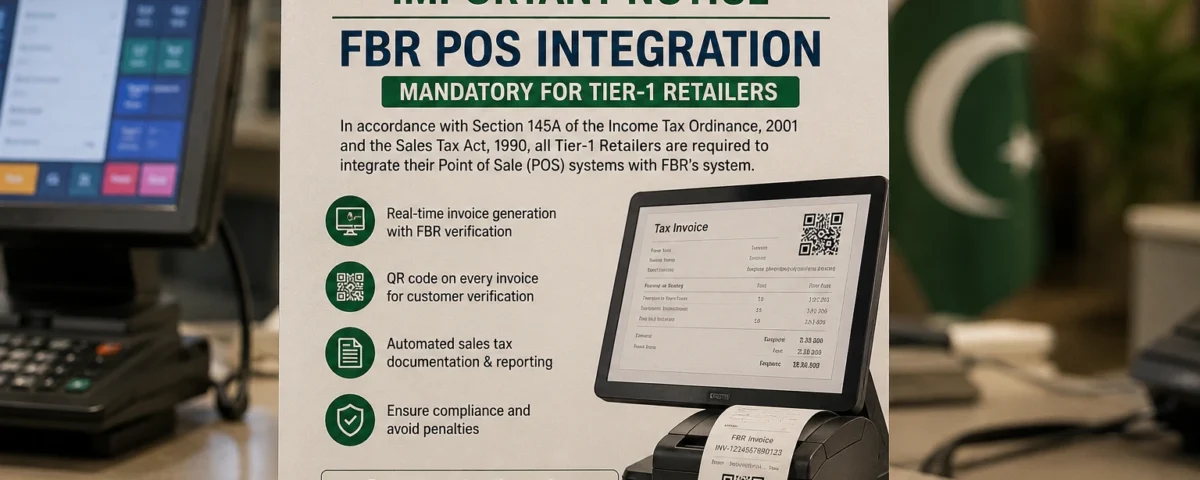
If your business has received notices from the Federal Board of Revenue, or you simply want to understand what FBR POS integration actually means and whether it applies to you or not, this guide has answers. Pakistan’s tax landscape has shifted significantly toward real-time digital documentation, and for Tier-1 retailers and service businesses, connecting your point-of-sale system to FBR is no longer optional. Here is everything you need to know heading into 2026.
What Is FBR POS Integration?
FBR POS integration is an online, real-time system that connects a business’s computerized sales setup directly to the Federal Board of Revenue’s servers. Every time a sale is recorded, the transaction is automatically documented, a unique FBR invoice number is generated, and a QR code is printed on the customer’s receipt.
Customers can then verify their invoice and confirm that sales tax has been properly collected by scanning this code through the Tax Asaan App. The system also automates the preparation of sales tax returns, significantly reducing manual paperwork and the chance of errors during filing.
Think of it less as software and more as a live bridge between your cash counter and the tax authority, one that runs silently in the background on every transaction.
Why Digital Invoicing Is Now Central to Tax Compliance
FBR’s push toward documented, verifiable invoicing is not accidental. It is part of a deliberate shift away from manual record-keeping and toward a tax infrastructure that governments can audit in real time. If you want a deeper look at the regulatory reasoning behind all of this, this breakdown of why FBR digital invoicing in Pakistan is mandatory covers the legal obligations, the timeline of enforcement, and what businesses across different sectors are expected to do.
Understanding the “why” makes the compliance steps far easier to follow and harder to ignore.
Who Is Required to Integrate?
Not every business falls under mandatory scope, but the criteria are broader than many assume. According to FBR regulations, the following retailers must connect their point of sale system:
- Retailers operating as part of a national or international chain of stores
- Businesses located in air-conditioned malls, plazas, or shopping centres (kiosks excluded)
- Retailers whose cumulative electricity bill over the last twelve consecutive months exceeds Rs. 1,200,000
- Wholesaler-cum-retailers engaged in bulk import and supply of consumer goods
- Retailers whose shop area measures 1,000 square feet or more
If your business matches any of the above criteria, POS-based tax integration is a legal requirement, not a preference.
Industries Covered Under FBR and PRA Integration
One of the most common misconceptions is that this requirement only applies to large supermarkets or clothing chains. The actual scope is much wider. Businesses required to connect their billing systems include:
- Restaurants and cafes (both ICT and Chapter VIIA)
- Retail outlets, garment stores, and textile businesses
- Beauty salons and aesthetic clinics
- Pharmacies and medical stores
- Private hospitals, dental clinics, and diagnostic labs
- Gyms and health clubs
- Jewellery shops
- Private schools and colleges
- Marriage halls and marquees
- Courier and logistics companies
- Importers, distributors, and wholesalers
- Photographers and event managers
The reach of PRA integration in Pakistan has expanded steadily, and more sectors continue to be brought under its scope each year. If your sector appears on this list, the question is not whether to integrate, it is how quickly you can get it done.
How the Integration Process Actually Works
The transaction flow is straightforward once the system is properly set up. Here is what happens at each sale:
- Customer arrives at the checkout counter
- Cashier creates an invoice within the POS software
- The system sends an automatic request for an FBR invoice number
- FBR’s system generates and returns a verified invoice number in real time
- Fiscal data is synchronized and stored automatically
- A QR code is generated and printed on the customer’s receipt
- The customer can verify the invoice using the Tax Asaan App
The entire sequence happens in seconds and requires no extra steps from your staff beyond their normal billing routine.
What Appears on an FBR-Verified Invoice?
An FBR-compliant receipt is not a standard receipt with a logo on it. It must include specific fields to be considered valid:
- Seller’s registered details and NTN
- Complete tax breakdown including the exact sales tax amount
- HSN codes where applicable
- A unique FBR-issued invoice number
- A scannable QR code for independent customer verification
Any receipt missing these elements is non-compliant, regardless of whether the correct tax amount was actually collected.
What Happens If You Do Not Comply?
Non-compliance carries real consequences. Businesses that ignore FBR integration notices can face:
- Financial penalties and recurring fines
- Tax audits triggered by irregular or unverified transaction records
- Suspension of business operations in severe cases
- Reputational damage with banks, suppliers, and larger clients
Beyond avoiding penalties, FBR compliance also works in your favour. Registered and compliant businesses are viewed as more credible, making it easier to secure bank financing, build supplier relationships, and pursue contracts with enterprise-level clients.
Sector-Specific Integration: The Beauty Salon Example
Every industry has its own billing quirks, service categories, and tax treatment variations, which is why a generic POS setup does not always translate smoothly into a compliant one. Beauty salons, for instance, deal with a mix of service charges, product sales, and package pricing that requires specific configuration. If you run a salon or work in the wellness space, this detailed guide on FBR POS integration for beauty salons walks through exactly what is needed, what common mistakes salons make during setup, and how to ensure every receipt is compliant from day one.
The same logic applies to clinics, gyms, schools, and restaurants, sector-specific configuration matters more than most businesses realise until something goes wrong.
myPOS and FBR-Compliant Point of Sale Software
myPOS.pk is one of Pakistan’s established point of sale platforms offering certified FBR integration for businesses across retail, restaurant, salon, healthcare, and services sectors. The system handles the FBR server connection automatically and generates compliant invoices at every transaction without requiring extra steps from the cashier.
For businesses with sector-specific needs, myPOS offers dedicated solutions for beauty salons, hospitals, gyms, dental clinics, schools, and diagnostic laboratories, each configured to handle the billing structure of that specific industry.
Getting Started With Tax Compliance in 2026
If you have been holding off on integration, 2026 is not the year to continue waiting. FBR enforcement activity is intensifying, and the documentation requirements are not going away. The good news is that modern point of sale software makes the technical side manageable, setup is fast, and day-to-day impact on staff is minimal once the system is live.
Start by confirming whether your business meets the mandatory criteria. If it does, the next step is choosing a certified solution that connects directly to FBR’s system through PRAL, generates verified invoices at every sale, and keeps your records audit-ready without additional manual effort.
Frequently Asked Questions
1. What is FBR POS integration and why does it matter?
It connects your billing system to FBR in real time so every sale is automatically documented and tax-verified.
2. Which businesses are required to integrate with FBR?
Tier-1 retailers, chain stores, air-conditioned outlet businesses, and many service sectors including restaurants, salons, clinics, and schools.
3. Can customers verify an FBR invoice themselves?
Yes, scanning the QR code on the receipt via the Tax Asaan App confirms the invoice was filed and sales tax collected.
4. What happens if a business ignores FBR integration notices?
Non-compliant businesses face financial penalties, tax audits, and potential suspension of operations.
5. Does FBR integration apply outside traditional retail?
Yes, restaurants, salons, hospitals, gyms, schools, marriage halls, couriers, and importers all fall under the requirement.