
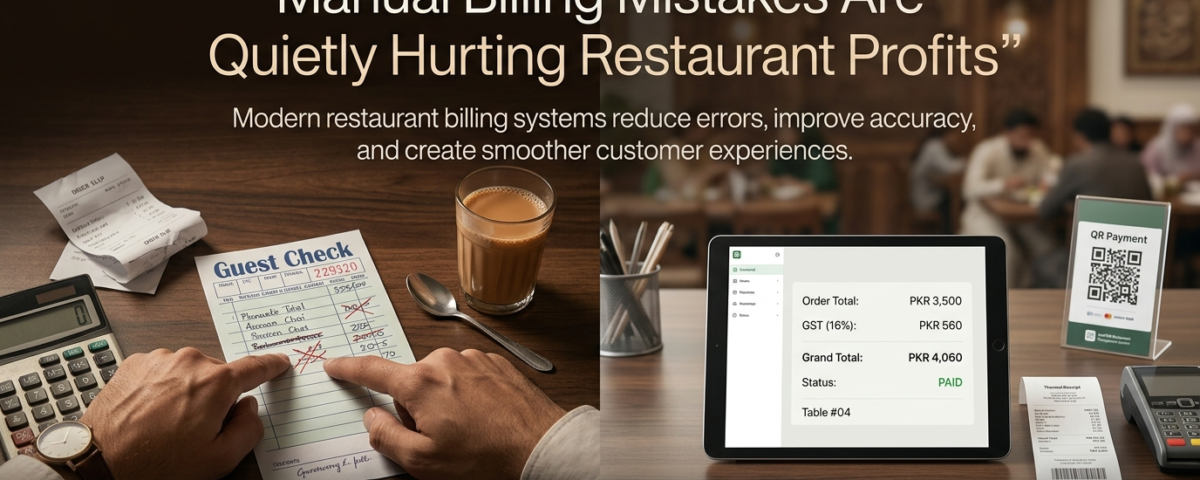
Running a restaurant in Pakistan has never been more competitive. From Lahore’s food streets to Karachi’s upscale dining strips and Islamabad’s café culture, owners are battling rising food costs, staff turnover, and increasingly demanding customers, all at the same time. Yet one problem that quietly bleeds revenue every single day remains surprisingly common: manual billing errors.
If your restaurant is still relying on handwritten orders, paper-based cash registers, or disconnected spreadsheets, you are likely losing money without even knowing it. Switching to a modern Restaurant Point-of-Sale system is no longer a luxury, it’s the difference between a thriving restaurant and one that barely breaks even.
The Real Cost of Getting the Bill Wrong
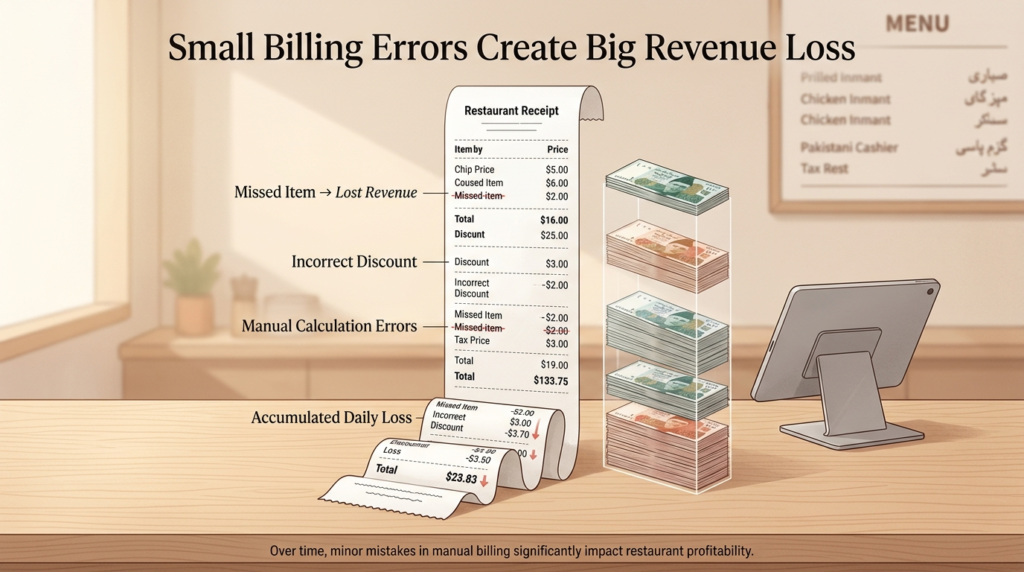
A single wrong bill might seem like a small inconvenience. But multiply that across dozens of tables, hundreds of orders, and thousands of transactions a month, and the picture changes entirely.
Manual billing mistakes in restaurants typically fall into three categories:
Order Entry Errors
When waitstaff scribble orders by hand and relay them to the kitchen verbally or through slips, miscommunication is inevitable. A table of six orders biryani for five, the kitchen makes six. A dine-in guest adds an extra drink, it never makes it onto the bill. These small slippages erode both revenue and food margins simultaneously.
Calculation Mistakes
Even experienced staff make arithmetic errors under pressure. Incorrect totals, missed discount calculations, or wrong tax applications create billing discrepancies that either overcharge customers (damaging trust) or undercharge them (damaging profit). In a busy dhaba or family restaurant handling 200+ covers a day, manual addition is a ticking time bomb.
Split Bill and Table Merge Confusion
Group dining is common across Pakistani restaurant culture. When multiple families sit together, split billing using manual methods becomes chaotic. Items get duplicated, missed, or assigned to the wrong table. The result? Angry customers, embarrassed staff, and lost revenue.
Why Pakistani Restaurants Are Slow to Adopt Digital Billing
The hesitation is understandable. Many restaurant owners in Pakistan, especially those running mid-sized or family-operated setups, believe that digital tools are expensive, complicated, or unnecessary for their scale.
But as explored in our guide on finding the right restaurant system, the real expense is not adopting smarter systems. Training staff on paper-based billing is time-consuming, prone to inconsistency, and completely non-scalable as your business grows.
There’s also the perception that “we’ve always done it this way.” But customer expectations in Pakistan are shifting. Diners today expect faster service, accurate bills, and digital payment options, especially in urban centers where competition is fierce.
How Billing Errors Silently Damage Your Restaurant’s Reputation
Beyond the direct financial loss, incorrect billing creates a customer experience problem. A customer who is overcharged feels cheated, and in the age of Google Reviews and social media, that frustration can go public fast. One viral complaint about being billed incorrectly can undo months of positive word-of-mouth.
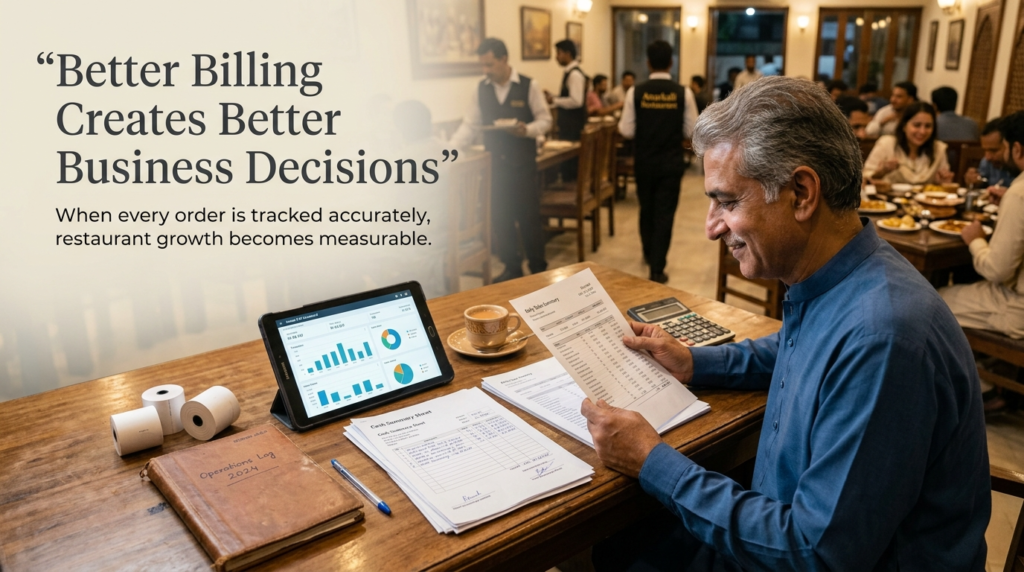
Conversely, consistent undercharging, which often goes unnoticed until monthly reconciliation, means your food cost percentages are off, your profit reports are inaccurate, and you’re making business decisions based on faulty data. As highlighted in our breakdown of best software for Pakistani restaurants, accurate real-time reporting is one of the most underrated benefits of moving away from manual systems.
What a Smarter Billing System Actually Fixes
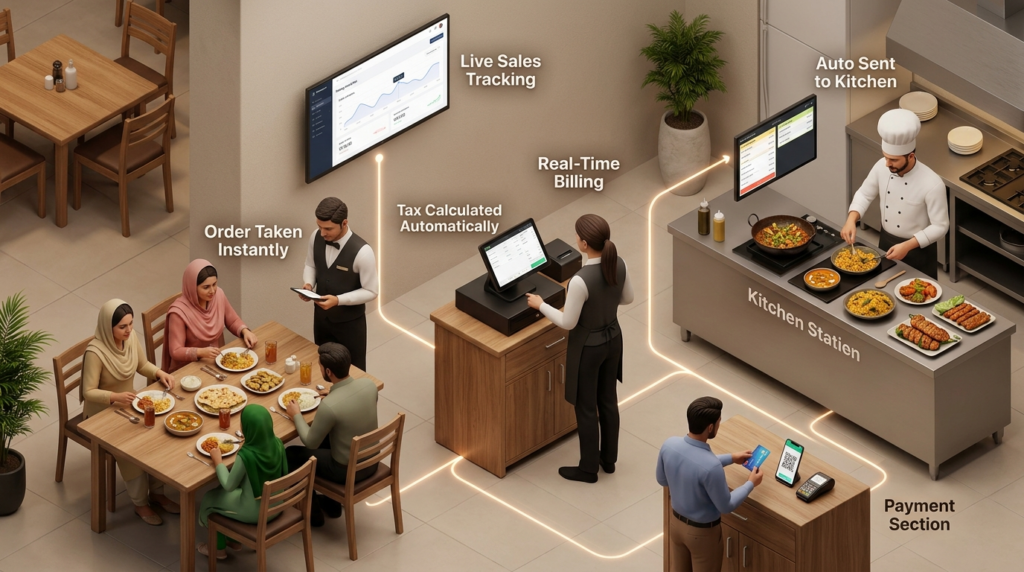
Modern restaurant management systems address every layer of the manual billing problem:
- Integrated order-to-kitchen flow ensures that every item a customer orders is automatically sent to the kitchen display, logged against the table, and added to the running bill, no slips, no miscommunication.
- Automatic tax and discount calculation removes human arithmetic from the equation entirely.
- Table and section management makes split billing and table merges a two-tap process instead of a negotiation between three confused waiters.
- End-of-day sales reports give you a clear, auditable record of every transaction, something a cash register simply cannot provide.
For restaurants evaluating their options, understanding the top restaurant billing system features is a great starting point before making any investment decision.
Final Thoughts
Manual billing is not just an operational inconvenience, it’s a direct threat to your restaurant’s revenue, reputation, and long-term growth. The good news is that the solution is well within reach for Pakistani restaurant owners of every size.
At myPOS, we’ve built our platform specifically for the realities of the Pakistani food and beverage industry, from multi-branch karahi houses to fast-growing café chains. If you’re ready to stop losing money to billing mistakes and start making decisions based on real data, it’s time to make the switch.
Frequently Asked Questions
Q: How do billing errors affect restaurant profitability in Pakistan? Billing errors directly reduce revenue through undercharging and inflate costs through over-serving. Over time, they also distort your financial records, making it impossible to accurately track profitability per dish, per shift, or per outlet.
Q: Is digital billing software suitable for small restaurants and dhabas in Pakistan? Absolutely. Many billing management tools today are available at affordable monthly rates and are designed to work on basic hardware including tablets and Android devices, making them practical even for small setups with tight budgets.
Q: What is the difference between a cash register and a restaurant billing system? A cash register records payments. A restaurant billing system manages the entire order lifecycle, from the moment a customer places an order to kitchen preparation, billing, payment, and post-sale reporting. The difference in operational insight is significant.
Q: Can a restaurant order management system reduce staff training time? Yes. When order entry, billing, and reporting are all handled through a single interface with guided workflows, new staff members typically get up to speed much faster than with paper-based or multi-tool systems.
Q: How does billing software help with tax compliance in Pakistan? A good billing system automatically applies the correct GST or service charges based on your configuration and generates tax-ready sales reports, reducing the manual effort required at the end of every tax period.